Top 10 Free Kudoboard Alternatives
Kudoboard is the default way offices collect goodbye and birthday messages, but it is not really free: paid boards start at $6.99 for 20 posts, and the free demo caps out after a handful of messages. If you just want everyone to sign one card without a paywall appearing at message 21, real options exist.
We checked the pricing page of every tool people recommend as a Kudoboard alternative and kept the ten where a 30-person board genuinely costs nothing, or close to it. The order is our recommendation, weighted toward generous free limits, no contributor signup, and whether the board is still online a year later. Reviews are grouped by the kind of tool you get, so rank numbers jump between groups.

How we picked these
- Actually free for a real group. A 25-30 person board has to cost $0. GroupGreeting (cards from ~$4.99, no free tier) and Thankbox (free to build, $5.99+ to send) were dropped for exactly this.
- Checked against live pricing pages. Every limit quoted here comes from the tool's own pricing or FAQ page as of September 25, 2026, linked in each review. Free tiers change; the links let you re-check.
- No contributor signup. The organizer can tolerate an account. Thirty busy signers can't. Tools where contributors post through a bare link rank higher; the one exception is flagged.
- Permanence counts. Some free cards are deleted a year after delivery. Each review says whether the board survives and whether a free export exists.
All ten at a glance
Ranked by how far the free tier actually goes. Each card links to the full review.

RecoCards
The only purpose-built group card we found with unlimited messages and signers at $0.

GreetBook
Zero friction: nobody needs an account, not even the organizer, and cards stay online indefinitely.

StickyArchive boards
A permanent public wall of sticky notes instead of a one-shot card. Contributors post without an account.

Soado
The rare free tier that includes a PDF export, so the keepsake costs nothing.

WiishWall
'Free forever' wish walls with messages, photos, GIFs, and video - and no stated caps at all.

SendWishOnline
A polished card-flip experience, free up to 30 signatures - but ad-supported and gone after a year.

GroupTogether
Card plus gift collection in one link. The card is free whenever you're pooling money anyway.

Padlet
The classroom-standard collaboration wall. Three free boards, unlimited posts on each.

Google Slides
One deck, one slide per person. Completely free, endlessly flexible, entirely manual.

IdeaBoardz
A spartan, long-running free sticky-note board with PDF and Excel export.
Free limits as listed on each tool's pricing or FAQ page, September 25, 2026.
Free group cards built for the job
Purpose-built send-a-card tools: one link goes around, everyone signs, the finished card goes to the recipient. On all five, contributors sign without creating an account.
1. RecoCards
Unlimited posts & signersNo account needed to signBest for: a straight Kudoboard swap for any size of group
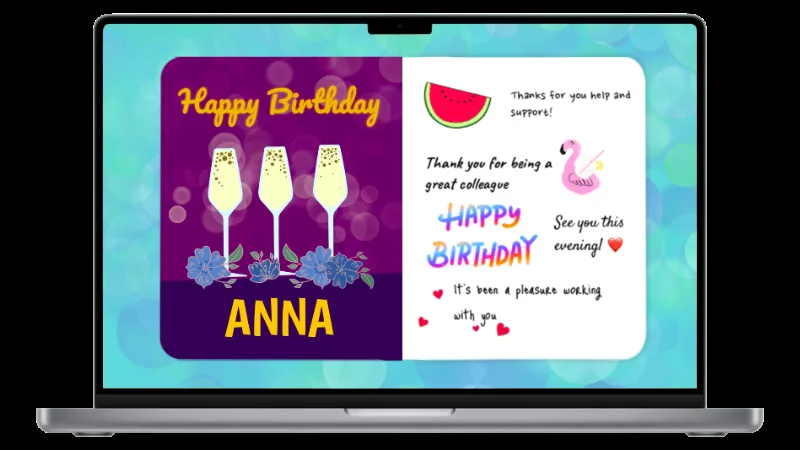
RecoCards' free tier is the whole product: unlimited signers, unlimited messages, photos and GIFs, scheduled delivery, and both a board layout and a fold-out greeting card layout. Its pricing page lists the free plan as '$0 per card' with unlimited signers, which is exactly the thing Kudoboard charges $6.99-$19.99 for.
Paid covers the keepsakes: a $2.49 one-time upgrade per card adds PDF and JPEG download, premium covers, and password protection, with a $5.99/month plan for heavy users that also removes ads. It is a smaller company than Kudoboard with a plainer template library, and the polish gap is visible - but nobody hits a paywall at message 21.
- Unlimited signers and messages on the free plan
- Photos and GIFs included free
- Board and greeting-card layouts
- Scheduled delivery at no cost
- Contributors sign without an account
- Group gift options if you want them
2. GreetBook
20 posts freeNo account for anyoneBest for: small and mid-size groups who want no signup for anyone
GreetBook removes every piece of friction the others keep: creating a card, signing it, and delivering it all work without an account - for the organizer too. Photos and GIFs are included on free cards, there is no watermark, and the site states cards stay online indefinitely.
The free ceiling is 20 posts per card, with a one-time premium upgrade for unlimited posts and extra backgrounds. For a team of 25 that makes it a near-miss; for a team of 15 it is the smoothest option on this list.
- No account required, even to create a card
- No watermark on free cards
- Photos and GIFs included free
- Cards stay online indefinitely
- One-time upgrade, not a subscription

4. Soado
Free, PDF export includedSigners need no accountBest for: groups who want a free downloadable copy of the finished card
Soado's free boards collect messages, photos, and GIFs through a share link, contributors need no app or login, and - unusually for this category - exporting the finished board as a PDF is free. Boards are private by default, reachable only through their unique link and not indexed.
It is a newer product with less public traction than RecoCards or GroupTogether, and the template selection leans on a premium upsell. But if the thing you actually want to keep is a file, this is the free tier that hands you one.
- Free PDF export of the finished board
- Contributors join by link, no login
- Photos and GIFs on free boards
- Boards private via unique link

5. WiishWall
No stated limitsNo signup to contributeBest for: a zero-cost wall with video messages
WiishWall positions itself as a free group card and wish wall: one shared link, unlimited wishes with photos, GIFs, and video, no signup to contribute, and 'free forever' language across its occasion pages. In a category where video is usually the first paid feature, that is a genuinely generous free tier.
The caution is provenance: the site does not say who runs it, and there is little public track record to lean on. Nothing looked wrong when we checked, but for a card you care about, keep copies of the photos you upload rather than treating the wall as your only copy.
- Video messages on the free tier
- No stated limit on wishes or signers
- No signup to contribute
- Occasion templates for weddings, farewells, get-well walls
6. SendWishOnline
30 signatures, adsSigners need no accountBest for: groups of up to 30 who want the most card-like free experience
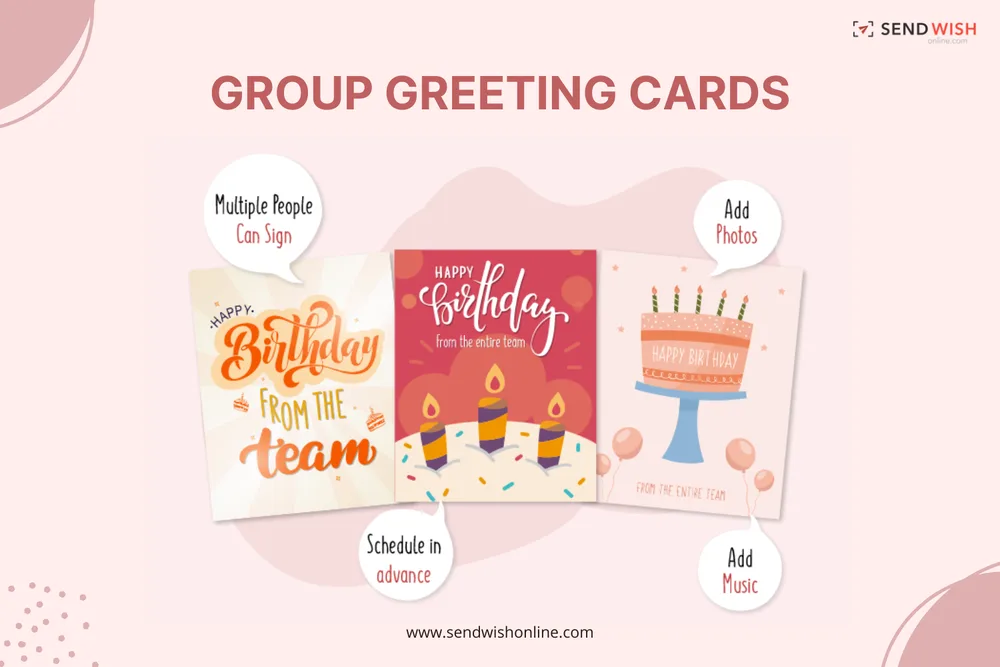
SendWishOnline's free cards allow up to 30 signatures, with photos, an actual page-turning card interface, and no account needed for signers (the organizer registers, Google login works). You can make up to 10 free cards a day, so the cap is per card, not per person.
Two catches put it mid-list: free cards carry ads, and a card stays online for one year from delivery - after that it is gone unless you paid the $2.99 per-card premium that unlocks PDF download, video, and unlimited signatures. As a one-week birthday card that is fine; as a keepsake it is a countdown.
- 30 signatures free per card
- Page-flip card presentation
- Signers need no account
- Premium is $2.99 one-time per card, not a subscription
Free walls and boards you can repurpose
Not card-shaped. These are shared walls where notes accumulate in the open. There is no delivery moment, but nothing caps how many people join in, and two of the three keep the board up permanently.

3. StickyArchive boards
Unlimited, kept foreverSigners need no accountBest for: an appreciation wall you keep forever rather than send once
Full disclosure: StickyArchive is this site. A board here is a shared wall of sticky notes - you sign in once to create it, then anyone with the link adds a sticky without an account, and notes appear instantly with no review step. Boards are free with no post limit, and everything is kept permanently; readers can heart notes and sort the wall by latest or most loved.
It is deliberately not a greeting card. There is no envelope moment, no PDF, and boards are part of a public archive (you can keep a board private, but then only you can open it). Choose it when the point is a living wall - a leaving wall the person can revisit years later, a team gratitude wall that keeps growing - rather than a sealed card delivered on Friday.
- No post limit and no paywall anywhere
- Contributors post instantly, no account
- Notes are archived permanently
- Hearts and most-loved sorting built in
- Handwritten sticky-note look, no setup
8. Padlet
3 boards freeVisitors can post by linkBest for: teachers and anyone already living in Padlet
Padlet is not a greeting card tool, but it has probably hosted more teacher-appreciation walls than any product actually built for them. The free plan gives you three boards with 20 MB uploads; visitors can post to a shared wall through a link, and posts on a board are not capped.
The three-board limit is the real constraint - a recurring organizer runs out fast and lands on paid plans. And because it is a general-purpose board, the send moment, backgrounds, and card framing are yours to improvise.
- Unlimited posts per board on the free plan
- Visitors can contribute via link
- Wall, grid, and timeline formats
- Mature product with schools-scale reliability
10. IdeaBoardz
Fully freeLogin optionalBest for: a five-minute text-only team thanks board
IdeaBoardz is a retrospective tool that doubles as the fastest free appreciation board there is: make a board, share the URL, and people add sticky notes - login optional, nothing paid anywhere, and the board exports to PDF or Excel for free.
It has run for well over a decade and looks like it: text-only stickies, an old-school interface, and no photos, GIFs, or card styling. It ranks last not because it fails but because it does the least - which, for a quick sprint-end thanks wall, can be exactly enough.
- Completely free, no tiers at all
- Free PDF and Excel export
- Login optional for contributors
- Running since the early 2010s
Free with a catch
Strong tools that only cost nothing under a condition. Worth it when the condition matches what you were doing anyway.

7. GroupTogether
Free when collecting $20+Contributors join by linkBest for: farewells and teacher gifts where you're collecting money anyway
GroupTogether bundles the two jobs most office farewells actually involve: everyone signs a card, and everyone chips in for a gift. The card alone costs A$5.50, but it becomes free when the group collects at least A$20 toward a gift card - which, for a leaving gift, you were probably doing anyway. Unlimited messages and photos, and a PDF download of the card, are included.
It is the most established tool on this list after Padlet - the company reports millions of users and thousands of workplaces - and the trade-off is equally clear: contributors pay a small service fee on the money pool, and a card with no collection is not free.
- Card is free with a $20+ gift collection
- Money pooling and eGift cards built in
- Unlimited messages and photos
- PDF download included
- Long track record and real support
9. Google Slides
Free, needs Google accountsEditors need a Google accountBest for: workplaces already on Google Workspace
Share a Slides deck with 'anyone with the link can edit,' give each colleague a slide, and you have a group card with no post limits, no ads, no expiry, and free PDF or PowerPoint export. In a Google Workspace office the whole thing takes ten minutes to set up.
The constraint is the account boundary: anonymous viewers are fine, but anyone editing needs to be signed into a Google account, and someone has to play designer - layout, template slide, and locking the finished deck are all on the organizer. Nothing reveals or delivers the card for you.
- No limits, ads, or expiry at all
- Free PDF and PPTX export
- Full design control
- Stays in Drive as long as you want
Which one should you use?
The same four facts decide it for most groups: how much the free tier holds, whether signers need an account, whether a free export exists, and whether the board is still there next year.
| # | Tool | Free limit | Signers need account | Free export | Stays online |
|---|---|---|---|---|---|
| 1 | RecoCards | Unlimited posts & signers | No | No | No expiry stated |
| 2 | GreetBook | 20 posts free | No | No | Stays online indefinitely |
| 3 | StickyArchive boards | Unlimited, kept forever | No | No | Permanent archive |
| 4 | Soado | Free, PDF export included | No | Yes | No expiry stated |
| 5 | WiishWall | No stated limits | No | No | 'Free forever' claimed |
| 6 | SendWishOnline | 30 signatures, ads | No | No | Online 1 year, then removed |
| 7 | GroupTogether | Free when collecting $20+ | No | Yes | Card kept after send |
| 8 | Padlet | 3 boards free | No | No | Kept within the 3-board cap |
| 9 | Google Slides | Free, needs Google accounts | Yes | Yes | Lives in Drive indefinitely |
| 10 | IdeaBoardz | Fully free | No | Yes | No expiry stated |
A straight Kudoboard swap: RecoCards - unlimited posts and signers free, whatever the group size.
Under 20 messages, zero friction: GreetBook - nobody makes an account, and the card doesn't expire.
A wall that lasts forever: a StickyArchive board - unlimited notes, no contributor accounts, archived permanently.
Collecting money anyway: GroupTogether - the card is free alongside a $20+ gift collection.
A classroom: Padlet - if the three free boards are enough, it is the smoothest wall teachers already know.
Start a free board on StickyArchive
A wall of sticky notes for a colleague, a class, or a team. No post limits, contributors need no account, and every note is kept permanently.
Questions people actually ask
Is Kudoboard free?
Not for a real group. Kudoboard's pricing page lists paid single boards from $6.99 (Lite, up to 20 posts) to $19.99 (Milestone, unlimited posts). There is a limited free demo board, but its post cap is a handful of messages and it lacks the delivery options, so a normal office card ends up paid.
Which well-known alternatives are not actually free?
GroupGreeting has no free tier at all (cards from about $4.99). Thankbox lets you build a card free but charges $5.99+ to send it. InvitiApp's free plan caps how many people can view a card before it asks for a one-time payment. Bravoboard's free starter caps posts. All four get recommended as 'free Kudoboard alternatives' anyway, which is why this list quotes each tool's own pricing page.
Do free group cards expire?
Some do. SendWishOnline removes cards one year after delivery unless you upgrade. GreetBook says cards stay online indefinitely, and StickyArchive keeps boards permanently. For anything you care about, use a tool with free export (Soado, IdeaBoardz, Google Slides) or download a copy while the card is live.
Can people sign without creating an account?
On most of this list, yes: RecoCards, GreetBook, Soado, WiishWall, SendWishOnline, and StickyArchive all let contributors post through a share link with no account. The exception is Google Slides, where anyone editing the deck needs a Google account.